We had our first breath of warm outdoor air from the gangway in San Salvador. We changed planes there and had an hour to buy something for Joan’s chapped lips and watch a young woman in a Luigi costume try to get people to play Wii. It’s about an hour’s flight from San Salvador to San Jose, and besides filling out our customs cards, we played sodoku. Neither of us had ever played sodoku before, and we had to do SOMETHING that we couldn’t do when the boys are around. There should be some other things, too. Our hotel has a very nice, warm, waveless pool. It’s indoors, which is probably the right choice since San Jose is in the mountains—the city is warm but the breeze is cool. The hotel is downtown, with multiple parks nearby. When we arrived, a brass band was playing in the park, and later there were acrobats. One unexpected highlight was the 10-block walk to the bus station to buy tickets for our trip to La Fortuna tomorrow. The airplane meals were fine, but small, and even if we’d been well-fed, the smell of the bakery would have pulled us in. It was tiny, and so stacked up with bread-goods that the propieter had to peek at us over the top. I think this was the first time we learned that it’s simply not true that “Everyone in Costa Rica speaks English.” And our little bit of Spanish was enough to avoid Pollo, and read the signs well-enough that she understood what we wanted. All the same, when it was time to pay she pointed at the cash register rather than say the numbers.
Saturday, February 12, 2011


Saturday, March 14, 2009
Today, we came to New Amsterdam and although most of the drive was very close to the ocean, the sea wall blocked any view of the ocean. New Amsterdam itself is a nice little down, and so far everywhere we’ve gone—4 or 5 places has been within walking distance of each other on the same main street that runs through the town. We had our first interview with an HIV+ woman today and she was really amazing. She told us about a dream she had where God showed her a garden and everyone in it had HIV—and it was her job to take care of them. She didn’t think she could do it, but she talked to her pastor and he said it was her calling. Later in the afternoon, we talked to a guy whose official job has nothing to do with HIV, but who seems to make a hobby out of talking to church groups and others. Like in Kenya, my feeling from being here is not that there needs to be more talk about condoms, but that monogamous marriage is not being celebrated. I won’t dismiss the argument that an over-emphasis on abstinence can compromise people’s ability to "prepare adequately for unexpected sexual encounters" (i.e. carry condoms). But the opposite is also true—promoting the idea that most people are promiscuous and thus need to carry condoms—makes abstinence or monogamy seem less realistic and undermines people's commitment.
Friday, March 13, 2009
I met yet another cool RPCV today, this one working at Catholic Relief Services. Being able to understand and appreciate another culture—while still understanding and appreciating your own— is so powerful. She was very good at dealing with some of our gotcha questions.
Because we were “working so hard,” I didn’t get to eat lunch, but only had a piece of vermicelli cake which is noodles in a sugary sauce with a good sized chunk of cinnamon bark. I don’t know if it’s baked or if it’s just sugar and time that kept it in a solid square shape while I was eating it. Interviewing people does energize me, but I do wish Americans would reconsider their fetishization of working through lunch.
It hasn’t rained as much as I’d expected, but today it rained very suddenly, hard enough to get me wet in the time it took to run from the front door of a building to a waiting taxi, and persisted for at least an hour. We took our taxi to the Pegausus so that we could interview Magda, a woman in her 70s who has been very active in Guyana’s woman’s movement. She had been educated in Britain—including Scotland—and reminded me of Joan’s grandmother Agnes.
Because we were “working so hard,” I didn’t get to eat lunch, but only had a piece of vermicelli cake which is noodles in a sugary sauce with a good sized chunk of cinnamon bark. I don’t know if it’s baked or if it’s just sugar and time that kept it in a solid square shape while I was eating it. Interviewing people does energize me, but I do wish Americans would reconsider their fetishization of working through lunch.
It hasn’t rained as much as I’d expected, but today it rained very suddenly, hard enough to get me wet in the time it took to run from the front door of a building to a waiting taxi, and persisted for at least an hour. We took our taxi to the Pegausus so that we could interview Magda, a woman in her 70s who has been very active in Guyana’s woman’s movement. She had been educated in Britain—including Scotland—and reminded me of Joan’s grandmother Agnes.
Thursday, March 12, 2009
from Linden
I spent at about an hour just sitting on the balcony and watching the town wake up. The mini-buses started arriving from about 7 and the flow was constant by around 8. Vendors were coming to market, school children in day-glo blue uniforms were coming to the Linden School of Excellence, trash men came hauling garbage behind a trailer, and nurses in white dresses boarded other mini-buses to go to their hospitals.
Linden is a world away from Georgetown; it was founded after colonialism and shows little in the way of British influence. The central business district lies on opposite sides of the Demerara River, and we had a good time exploring the market stalls and buying hot sauce. The market is covered and so its dark among the stalls and the passages narrow, but the people were very friendly. The town is town and it feels especially tiny in comparison with the Bauxite mining operations that surround it: enormous piles of grayish dirt, multiple levels of conveyor belts and waterfalls, and firestacks that spew smoke so thick it looks like whipped cream.
Linden is a world away from Georgetown; it was founded after colonialism and shows little in the way of British influence. The central business district lies on opposite sides of the Demerara River, and we had a good time exploring the market stalls and buying hot sauce. The market is covered and so its dark among the stalls and the passages narrow, but the people were very friendly. The town is town and it feels especially tiny in comparison with the Bauxite mining operations that surround it: enormous piles of grayish dirt, multiple levels of conveyor belts and waterfalls, and firestacks that spew smoke so thick it looks like whipped cream.
Wednesday, March 11, 2009
to Linden
We celebrated Pagwah some more, this time by driving around until we found some people playing with water and playing with colors. A few of us got out of the taxis so that we could first be dowsed with water and then smeared with red and blue powder. They gave me some red powder so that I could also color some people.
I wore my colored shorts on the way to Linden and they made a nice conversation piece when we stopped to help someone with a flat tire. Some Amerindians had also come out to look at the tire and although they hadn’t played with colors themselves they could see that I had. We didn’t understand each other very well, but they tried and they were very friendly.
We arrived in Linden at about dusk, and there was still a mood of holiday excitement. After dinner, we sat outside the pastry shop and I noticed a boy copying my gestures while I talked at the phone. His name was Devon and he told me he was 14, and a couple of my friends that he was 12, 13. His favorite subject is maths and he is saving money to buy a bike. I was very tempted to give him the last 3,000 ($15) that he needs.
I wore my colored shorts on the way to Linden and they made a nice conversation piece when we stopped to help someone with a flat tire. Some Amerindians had also come out to look at the tire and although they hadn’t played with colors themselves they could see that I had. We didn’t understand each other very well, but they tried and they were very friendly.
We arrived in Linden at about dusk, and there was still a mood of holiday excitement. After dinner, we sat outside the pastry shop and I noticed a boy copying my gestures while I talked at the phone. His name was Devon and he told me he was 14, and a couple of my friends that he was 12, 13. His favorite subject is maths and he is saving money to buy a bike. I was very tempted to give him the last 3,000 ($15) that he needs.
Tuesday, March 10, 2009
rules
I got three text messages from my son today and two from my wife so I am very happy. I can imagine us living in Guyana for a little while. I know there are dangers here, but Peace Corps is cautious about where they send people and the volunteers don’t live under our rules regarding not going out without a taxi and/or a supervisor.
If I were allowed to, I would go swim in the ocean which I can see from my balcony and which can be accessed by going to the second floor, then down the Kingston wing, down the steps, a few steps, through the sidewalk, jumping the fence and running over a small dune. The people few down there are poor, swim in their underwear, and while one might ask for your shirt her friend will tell you don’t give her nothing.
We went back to Salt and Pepper Food Court for lunch. Wanting to mix it up a little, I ordered the potato curry roti as did my colleague. Our meals both looked remarkably like the chicken curry he had eaten the day before. After a couple of enquiries, they relented and added a piece of curried potato to each of our plates—sarcasm?
If I were allowed to, I would go swim in the ocean which I can see from my balcony and which can be accessed by going to the second floor, then down the Kingston wing, down the steps, a few steps, through the sidewalk, jumping the fence and running over a small dune. The people few down there are poor, swim in their underwear, and while one might ask for your shirt her friend will tell you don’t give her nothing.
We went back to Salt and Pepper Food Court for lunch. Wanting to mix it up a little, I ordered the potato curry roti as did my colleague. Our meals both looked remarkably like the chicken curry he had eaten the day before. After a couple of enquiries, they relented and added a piece of curried potato to each of our plates—sarcasm?
Monday, March 09, 2009
Georgetown, Monday
I’m missing my family a lot and they are missing me, especially my oldest son. He’s asked me to never again go away without him, and I want to honor his request at least until he’s older and at least when I’m going to be away for this long. Although when I explained what I was doing he told me he wanted to be a lawyer, too.
In between interviews, we had lunch at the “Salt and Pepper Food Court,” which is a buffet restaurant that sells takeaway food downstairs. We bought our lunch downstairs and ate at the tables. It’s close to the area that in Kenya I’d call “the stage” where all the mini-buses wait for passengers, and also to the Staboek market, so it’s a great place for watching a commotion.
After our interviews, we went to an event at the University of Guyana to recognize International Women’s Day and hosted by Professor Bibian Isoto. Bibian is originally from Uganda and was dressed kienyeji (“traditionally”—kind of) and knew a little bit of Swahili. One of the other professors knew quite a bit more—although he was Guyanese, he had spent some time in TZ.
In between interviews, we had lunch at the “Salt and Pepper Food Court,” which is a buffet restaurant that sells takeaway food downstairs. We bought our lunch downstairs and ate at the tables. It’s close to the area that in Kenya I’d call “the stage” where all the mini-buses wait for passengers, and also to the Staboek market, so it’s a great place for watching a commotion.
After our interviews, we went to an event at the University of Guyana to recognize International Women’s Day and hosted by Professor Bibian Isoto. Bibian is originally from Uganda and was dressed kienyeji (“traditionally”—kind of) and knew a little bit of Swahili. One of the other professors knew quite a bit more—although he was Guyanese, he had spent some time in TZ.
Sunday, March 08, 2009
worship
I went to church twice—to the Methodist in the morning and to the Catholic Cathedral at around 5pm. The supervisors are rather cautious about allowing us to leave the hotel without a chaperone, and while I am indeed full of Christian zeal, I expect I would have done something else in the evening if I’d had more options. And I probably would have missed out. Although the homily was typically difficult to hear, the ritual was moving. The hymns were sang mainly by the two women who also played the organ (and maybe another instrument) and, they used the same otherworldly, very high and tremulous voices that I’d heard at pagwah the night before. And as they started singing the first hymn the wind picked up to rustle the flags and the fluorescent lights came on to add both light and a low, buzzing hum.
And Pagwah the night before—this is a Hindu holiday and took place at a temple. From what I heard, the Pagwah events started with a religious ceremony and ended with the variety show that we watched. A band sang what seemed to be pop songs, using mainly what I would call “Indian” instruments plus a keyboard and conga drums. The band’s performances alternated with performances by a group of very energetic dancers who danced to Indian disco music.
And Pagwah the night before—this is a Hindu holiday and took place at a temple. From what I heard, the Pagwah events started with a religious ceremony and ended with the variety show that we watched. A band sang what seemed to be pop songs, using mainly what I would call “Indian” instruments plus a keyboard and conga drums. The band’s performances alternated with performances by a group of very energetic dancers who danced to Indian disco music.
Saturday, March 07, 2009
We had a busy day of interviews in the course of which I met a former Peace Corps Volunteer. Talking to her (as well as with a current Peace Corps Volunteer later) reminded me of what an excellent group of people we Peace Corps Volunteers are. They showed a similar combination of wisdom and hope; despite knowing the challenges for themselves and Guyana, they were cheerfully committed to their work.
We also spoke to some CSWs (Commercial Sex Workers—a lot could be written about the names we apply to people who engage in sex in order to get money, whether for basic necessities or something else, but I’ll leave that to others, at least for now) and of course that’s not a common experience, especially since we were speaking (in an oblique way most of the time) about their sex work. Supposedly men will pay double for sex without a condom, and considering the poverty and desperation involved, I’m not surprised that many women accept, even if those we talked to insisted that they would not. One way to explain the man’s recklessness is that such men know they are infected, but another explanation is “cognitive dissonance,” that such men separate themselves from the entire experience o f “picking a fare.”
Because Sunday was an off-day, we went out for dinner at Celina’s, the only restaurant in Georgetown with an Oceanside view. The water here is definitely the Atlantic rather the Caribbean, and it has the same gray-green color and generally foreboding look as it does in, for instance, Maryland. We waited a long time for our food and I got to feeling a little quiet and sullen. (As opposed to quiet and happy, my usual mode).
We also spoke to some CSWs (Commercial Sex Workers—a lot could be written about the names we apply to people who engage in sex in order to get money, whether for basic necessities or something else, but I’ll leave that to others, at least for now) and of course that’s not a common experience, especially since we were speaking (in an oblique way most of the time) about their sex work. Supposedly men will pay double for sex without a condom, and considering the poverty and desperation involved, I’m not surprised that many women accept, even if those we talked to insisted that they would not. One way to explain the man’s recklessness is that such men know they are infected, but another explanation is “cognitive dissonance,” that such men separate themselves from the entire experience o f “picking a fare.”
Because Sunday was an off-day, we went out for dinner at Celina’s, the only restaurant in Georgetown with an Oceanside view. The water here is definitely the Atlantic rather the Caribbean, and it has the same gray-green color and generally foreboding look as it does in, for instance, Maryland. We waited a long time for our food and I got to feeling a little quiet and sullen. (As opposed to quiet and happy, my usual mode).
Friday, March 06, 2009
jet to Guyana
On my flight to Guyana, I sat next to a Guyanese man who, upon later reflection, I think may have been involved in drug trafficking. He runs a hardware store in Brooklyn and owns several rental properties there, and makes a trip to Guyana every six weeks to spend a week relaxing. A man in his fifties, with lots of “tough love” wisdom on a variety of subjects (“And if you ever get into any kind of trouble where there doesn’t seem to be any way out, remember that it’s a result of your not working hard enough.”), I feel disrespectful suggesting he was doing anything except relaxing. But the regular trips to Guyana, combined with a couple of the stories he told me, has made me wonder if he doesn’t carry something back with him, even if he pretends not to know what he’s doing and despises everyone else involved.
About those stories—The first one isn’t so much a story, but a best practice. When he arrives in Guyana, he told me, he would collect his luggage and retrieve a long knife from his suitcase. When he gets a taxi for the four-hour ride to the east coast, he’ll show the driver the knife as a warning. He doesn’t want the driver to use his cell phone during the journey or to drive down any dead ends. If they get attacked by bandits, the driver dies.
The other story is about a time when he got beat up by drug dealers in New York. The details were muddled—it seemed to have something to do with activity going on in one of his rental properties. The police considered him a suspect for a while, but cleared him (I think). Even the attackers came back and apologized that they’d attacked the wrong person. It was hard to focus on details, as I was a little distracted by the photos he had to go with it—a few of himself with a badly bruised face after the attack, and one of his very bloody shirt.
About those stories—The first one isn’t so much a story, but a best practice. When he arrives in Guyana, he told me, he would collect his luggage and retrieve a long knife from his suitcase. When he gets a taxi for the four-hour ride to the east coast, he’ll show the driver the knife as a warning. He doesn’t want the driver to use his cell phone during the journey or to drive down any dead ends. If they get attacked by bandits, the driver dies.
The other story is about a time when he got beat up by drug dealers in New York. The details were muddled—it seemed to have something to do with activity going on in one of his rental properties. The police considered him a suspect for a while, but cleared him (I think). Even the attackers came back and apologized that they’d attacked the wrong person. It was hard to focus on details, as I was a little distracted by the photos he had to go with it—a few of himself with a badly bruised face after the attack, and one of his very bloody shirt.
jet to Guyana
On my flight to Guyana, I sat next to a Guyanese man who, upon later reflection, I think may have been involved in drug trafficking. He runs a hardware store in Brooklyn and owns several rental properties there, and makes a trip to Guyana every six weeks to spend a week relaxing. A man in his fifties, with lots of “tough love” wisdom on a variety of subjects (“And if you ever get into any kind of trouble where there doesn’t seem to be any way out, remember that it’s a result of your not working hard enough.”), I feel disrespectful suggesting he was doing anything except relaxing. But the regular trips to Guyana, combined with a couple of the stories he told me, has made me wonder if he doesn’t carry something back with him, even if he pretends not to know what he’s doing and despises everyone else involved.
About those stories—The first one isn’t so much a story, but a best practice. When he arrives in Guyana, he told me, he would collect his luggage and retrieve a long knife from his suitcase. When he gets a taxi for the four-hour ride to the east coast, he’ll show the driver the knife as a warning. He doesn’t want the driver to use his cell phone during the journey or to drive down any dead ends. If they get attacked by bandits, the driver dies.
The other story is about a time when he got beat up by drug dealers in New York. The details were muddled—it seemed to have something to do with activity going on in one of his rental properties. The police considered him a suspect for a while, but cleared him (I think). Even the attackers came back and apologized that they’d attacked the wrong person. It was hard to focus on details, as I was a little distracted by the photos he had to go with it—a few of himself with a badly bruised face after the attack, and one of his very bloody shirt.
About those stories—The first one isn’t so much a story, but a best practice. When he arrives in Guyana, he told me, he would collect his luggage and retrieve a long knife from his suitcase. When he gets a taxi for the four-hour ride to the east coast, he’ll show the driver the knife as a warning. He doesn’t want the driver to use his cell phone during the journey or to drive down any dead ends. If they get attacked by bandits, the driver dies.
The other story is about a time when he got beat up by drug dealers in New York. The details were muddled—it seemed to have something to do with activity going on in one of his rental properties. The police considered him a suspect for a while, but cleared him (I think). Even the attackers came back and apologized that they’d attacked the wrong person. It was hard to focus on details, as I was a little distracted by the photos he had to go with it—a few of himself with a badly bruised face after the attack, and one of his very bloody shirt.
Monday, July 21, 2008
friends
Joan’s discovered facebook. I don’t know whose invitation to join finally triggered her to register, but now that she has, she’s added a lot of friends (including me!) and is looking for more especially among people she half-remembers from high school. I’ve gotten into it, too and maybe everyone has, because it seems like more people are inviting me, as well. Interest in facebook is growing in Belgium also—the word often seems to jump out of overheard, otherwise French or Dutch conversations.
One of my friends, who despite her living in Brussels, I’d barely communicated with this summer, finally came over for dinner last night. She had a friend (boyfriend? I don’t think she would have worn that dress for just us.) with her and he and I got on well. Joan and I talked about afterwards how although we’ve had a few people over, none of them have been Belgian. Our friend actually lives in the U.S. most of the time and is from Congo. And her friend was Dutch.
Lux
Although there are a lot of good bars and restaurants in this neighborhood, when my office decided to do a happy hour, we did it at the office, with drinks in the “refectoire” (“break room”) and food—cheeses, quiches, cold cuts, olives—on tables set up in the hall. It started right on time at about 5:30 with almost everyone attending. What did we talk about: Flemish history, whether it’s customary in Bru to greet people in French, Dutch or not at all, Luxembourg (because I was about to go there), other people’s holiday plans, a proposed soccer tournament (on the Play Station 3).
There’s a Chi-Chi’s in Luxembourg, in the main square, next to the Pizza Hut. There are also several more traditional tourist trap restaurants, and we ended up with falafels. Our first day there, we took a tour of the “casements” the underground passages that were built in the middle ages when the whole city was a fortress, and although theoretically interesting, the experience was like going down to the basement but with a lot more steps. So I’m really glad we stayed the night and went back to the centre again the second day, and found the “other old town,” tucked into the valley, again dating from the days when the city was a fortress. I don’t generally care that much about food so I think it means something to say I ate one of the best meals of my life there—potatoes au gratin with spinach. It sounds really ordinary, but they put something in that sauce and it was really good.

Monday, March 24, 2008
Basic Swahili (Kenyan)
Greetings
Most greetings have a customary response, although “nzuri” (“good”) will work in most cases
Informal
Greeting Response
Sasa ______________________________Fiti
Mambo __________________________Poa / Safi
Niaje ______________________________Fiti / Nzuri
More formal
Greeting Response
Habari yako (to one person) _____________ Nzuri / salama/ njema
Habari zenu (plural) ___________________ Nzuri/ salama/ njema
Formal (presenter addressing a group)
Greeting Response
Hamjambo (plural) ______________________________Hatujambo
“For tourists” (although I’m sure I’ve heard Kenyans say this to each other)
Greeting Response
Jambo ______________________________Jambo (“Yes I am a tourist.”)
Jambo ______________________________sana/ jambo nyingi/ nzuri
For most all these responses, feel free to add “sana”, meaning “very.”
Other words
Nataka . . . ______________________________I want . . .
Sitaki . . . ______________________________I don’t want (a blunt refusal)
Maji (moto) ______________________________water (hot)
Chai ______________________________tea
Maziwa ______________________________ milk
Nyama ______________________________ meat
Mboga ______________________________vegetables
Tamu ______________________________tasty
Niko ______________________________sawa I’m okay (a polite refusal)
Ndiyo ______________________________Yes
Hapana ______________________________No
Asante (sana) ______________________________Thank you (very much)
Bwana ______________________________Polite address to a man
Mama ______________________________Polite address to a woman with children (“Bibi,” the direct equivalent to “Bwana,” is rarely used in Kenya except to mean one’s own wife.)
Kwaheri ______________________________ Goodbye
Tutaonana ______________________________See you later
Safari njema ______________________________ Nice journey
Pronunciation
Each of the vowels is always pronounced in the same way:
A is like the a in “safari”.
E is like the a in the English word “day”.
I is like the i in “safari”
O is like the o in the English “go”
U is like the u in the English word “flu”
Wednesday, March 14, 2007
USVI
One of the best things about Magen's Bay was getting there. We'd driven up and down the same road twice (the first time looking for a place to turn around actually) and some Cub Scout den mothers stopped to ask us if we needed directions. They were very nice and one of them, a very proud Alumna of an American college/sorority led us in her car, driving rather fast on the hilly, windy roads. Once we got to the other side and were about to descend, that first glimpse of the turquoise bay ringed with white sand and palms, gave us that feeling that we were about to step into a postcard. After the beach, we drove east, looking for somewhere to eat and ended up at Duffy's Love Shack in Red Hook, St. Thomas's second town. It's considerably less picturesque than Charlotte, though with more accessible services like drug stores and a post office for (middle-class) people who actually live on the island and already have enough duty-free diamonds. Lots of "regular sized" sailboats here. When we got back to Charlotte, there was a music festival going on and we watched one of the acts, the JDPP Jamerz. These were all kids from the JD home ("Taking Weapons form the Hands of Children and Replacing them with Musical Instruments"). They played with the enthusiasm you'd expect from kids on furlough and the small crowd reciprocated with encouragement.
We crossed to St. John on the ferry and this gave a strong impression of just how small and how close together these islands are. We sailed form Charlotte Amalie and of course we didn't go into each of the little bays and inlets. In a rather slow boat it took maybe 15 minutes to get out of the harbor, 20-25 to get down to the east end and then 15 to actually cross the straits of open water between the two islands.
St. John looks a lot like St. T when you arrive with a rather large hotel on cruz bay and a concentration of shops and cafes on the waterfront. Town however, is very small, and the country is much more wild. This is largely because it mainly national park and so there's little in the way of either tourist-oriented or local construction, but probably due to a slightly different climate. It was raining very hard when we arrived in St. J and the vegetation was much more thick and green. St. T was dry and rocky with a lot of cactus-like plants.
We rode in a jitney, a big pick-up truck with three or four rows of open-air seats in the back. They are very different from matatus in that: they leave as soon as they've collected a few passengers, the drivers are sometimes women, and they cost a good bit, probably as much as taking a private taxi on the mainland. But as Nate said, "Riding in a truck sure is fun." Almost as soon as we got out of Cruz Bay we were inside the National Park. As always, I felt incredible gratitude for the NP System, seeing both that so much of the landscape was kept in a natural state and that it was available to anyone who wanted to visit it. This is the double whammy of the resorts-- they clear an enormous amount of land, re-finish it as an artificial "landscape" and then restrict access so that empty chairs far outnumber people.
We camped at Cinnamon Bay and I think we all liked this beach the best of any we visited. It was relatively large, maybe because it had once been two bays that "grew together". There was a sandy point at about the halfway point with a sizable cay a couple hundred yards offshore.
We crossed to St. John on the ferry and this gave a strong impression of just how small and how close together these islands are. We sailed form Charlotte Amalie and of course we didn't go into each of the little bays and inlets. In a rather slow boat it took maybe 15 minutes to get out of the harbor, 20-25 to get down to the east end and then 15 to actually cross the straits of open water between the two islands.
St. John looks a lot like St. T when you arrive with a rather large hotel on cruz bay and a concentration of shops and cafes on the waterfront. Town however, is very small, and the country is much more wild. This is largely because it mainly national park and so there's little in the way of either tourist-oriented or local construction, but probably due to a slightly different climate. It was raining very hard when we arrived in St. J and the vegetation was much more thick and green. St. T was dry and rocky with a lot of cactus-like plants.
We rode in a jitney, a big pick-up truck with three or four rows of open-air seats in the back. They are very different from matatus in that: they leave as soon as they've collected a few passengers, the drivers are sometimes women, and they cost a good bit, probably as much as taking a private taxi on the mainland. But as Nate said, "Riding in a truck sure is fun." Almost as soon as we got out of Cruz Bay we were inside the National Park. As always, I felt incredible gratitude for the NP System, seeing both that so much of the landscape was kept in a natural state and that it was available to anyone who wanted to visit it. This is the double whammy of the resorts-- they clear an enormous amount of land, re-finish it as an artificial "landscape" and then restrict access so that empty chairs far outnumber people.
We camped at Cinnamon Bay and I think we all liked this beach the best of any we visited. It was relatively large, maybe because it had once been two bays that "grew together". There was a sandy point at about the halfway point with a sizable cay a couple hundred yards offshore.
Thursday, December 14, 2006
Wednesday, August 16, 2006
home
JOan picks me up at the airport alone. As much as I was looking forward to seeing my boy, this is perfect. I am so so happy to see her. She is in "work mode"-- maybe even wearing her badge. We have lunch together at Duangrats and then I take her back to her office.
I pick up Nate from daycare. He is asleep, so his welcome is very restrained indeed. He wakes gradually and we go swimming.
I'm happy to be home. I tell Joan as much as I can and expect to tell her more over the next few days. I see Beth briefly on her way to go rafting. I talk to my mom on the phone. I am so tired that I fall asleep in Nate's bed while he is going to sleep. By the time I wake up and go through to my own bed, Joan is also asleep.
I pick up Nate from daycare. He is asleep, so his welcome is very restrained indeed. He wakes gradually and we go swimming.
I'm happy to be home. I tell Joan as much as I can and expect to tell her more over the next few days. I see Beth briefly on her way to go rafting. I talk to my mom on the phone. I am so tired that I fall asleep in Nate's bed while he is going to sleep. By the time I wake up and go through to my own bed, Joan is also asleep.
Tuesday, August 15, 2006
the trip back
I am so much wanting to get home. It feels like I've been away for a long time and I'm sensitive to the burden I've put on Joan, more so than earlier. I know the thing to do is not feel guilty about being away, but instead feel grateful and excited about the experience she allowed me to have.
LEaving Nairobi, Esther's sister was very kind in that she picked me up, took me to the westlands roundabout so I could give Celine a phone for Wambo, and then carried Celine, her husband, and her sister to the airport so they could say goodbye. We talked little on the way over, since I was both a little drowsy and a little anxious about the journey ahead of me. Still it felt good to have so many nice people around me.

I had a long layover in Addis and the airline gave me a room at the De Leopol Hotel-- whose staff provide the best customer service in the world. I had no money and wanted to know if I could walk to an ATM. The simple answer would be no, we're very sorry, but why not enjoy a movie in the lounge? Their solutin was to call the big hotels to find one with an ATM and then call a taxi and lend me the fare. Frewoyni and Asal, amesegenello!
LEaving Nairobi, Esther's sister was very kind in that she picked me up, took me to the westlands roundabout so I could give Celine a phone for Wambo, and then carried Celine, her husband, and her sister to the airport so they could say goodbye. We talked little on the way over, since I was both a little drowsy and a little anxious about the journey ahead of me. Still it felt good to have so many nice people around me.

I had a long layover in Addis and the airline gave me a room at the De Leopol Hotel-- whose staff provide the best customer service in the world. I had no money and wanted to know if I could walk to an ATM. The simple answer would be no, we're very sorry, but why not enjoy a movie in the lounge? Their solutin was to call the big hotels to find one with an ATM and then call a taxi and lend me the fare. Frewoyni and Asal, amesegenello!
Monday, August 14, 2006
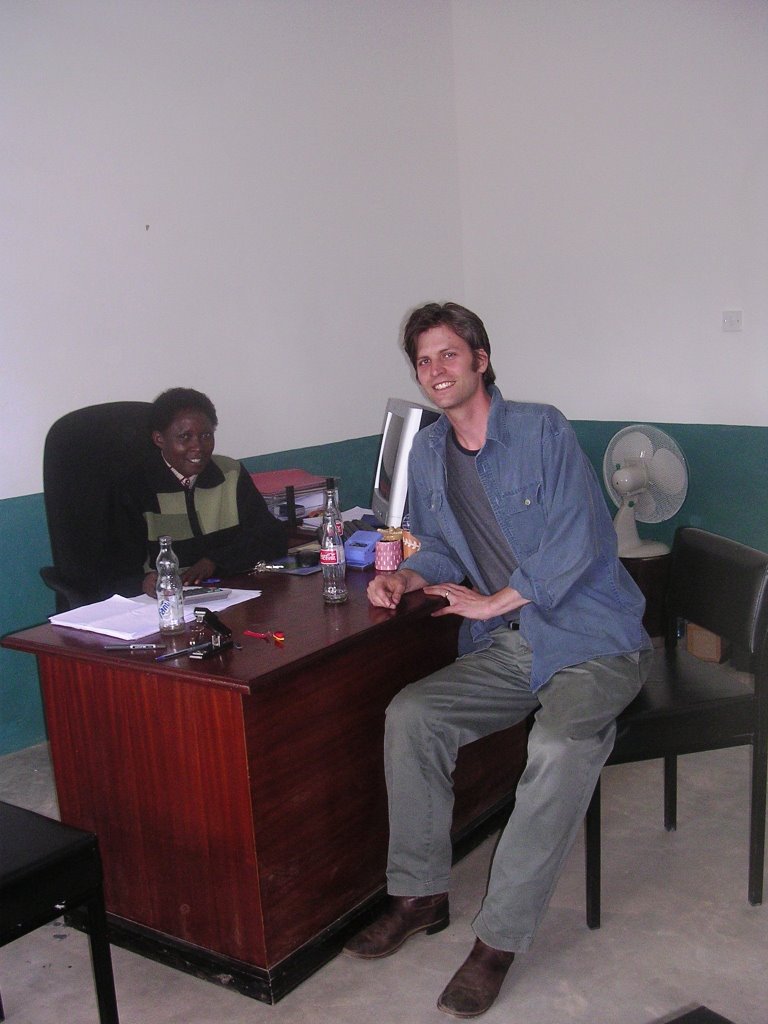
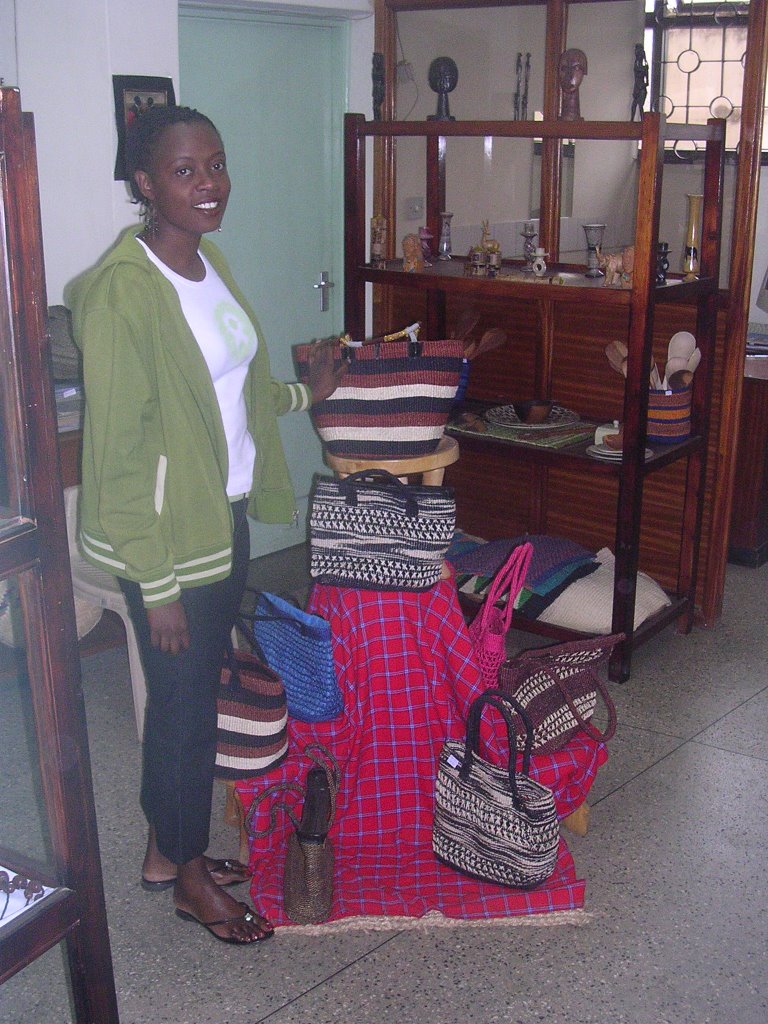
So I finally got to see the Mango True Mirage production center. It's a simple place, a typical Kenyan office compound, one-story with many single rooms accessed from a central courtyard. What's remarkable is the diversity of their product line and their refusal to mass-produce the same items over and over. I especially like their bannana fibre and saisal baskets and found it interesting to see someone painting their wooden carvings.
My student meeting wasn't what I'd expected in that none of my students showed up. Paul-- who'd chosen a good place for us to meet-- found that he couldn't get off from work at Uchumi's (IT dept.) and instead sent his brother Charles with a formal typed letter of apology. Also there were Beth's brother Maina and her cousin John. Since I was expecting to see my students, I didn't recognize anyone at first, but it was great to see MAina and JOhn again and I was happy to meet Charles.
After some errands around Nairobi, I settled into my hotel in Parklands. I went back out to Westlands for email and felt safe if a little on edge. Maybe in some way I felt safer without Joan because I didn;t have to worry about anyone except myself, but I think there are a lot less streetboys in Nairobi and also more pedestrains.
Sunday, August 13, 2006
Nairobi to Machakos
I go to Sunday morning services at the main Presbyterian church in Nairobi. (St. Adnrew's) There's a children's choir, but like in America, they are shy and quiet. All the music throughout the service is purely voices and the adult singers are very good.

I meet Lucy and her husband Kim for lunch and also meet their son Geoff and their niece Kandi. Geoff reminds me of Nate. He refuses to stay in his seat, but wanders around the restaurant, giving me an excuse to chase him and scoop him up and hold him.
I go to Machakos in the afternoon and hangout with Anne and her friend Andrew. I'd been to Kenyan bars and nyama choma joints before, but had never spent the whole afternoon in such a place. I'm not so much on those typical male interests of football on TV, beer, roast meat, lots of pictures of women on the walls but only one (Anne) in actual attendance. Still, I had a good time-- there are few things I enjoy doing more than something I don't normally do.
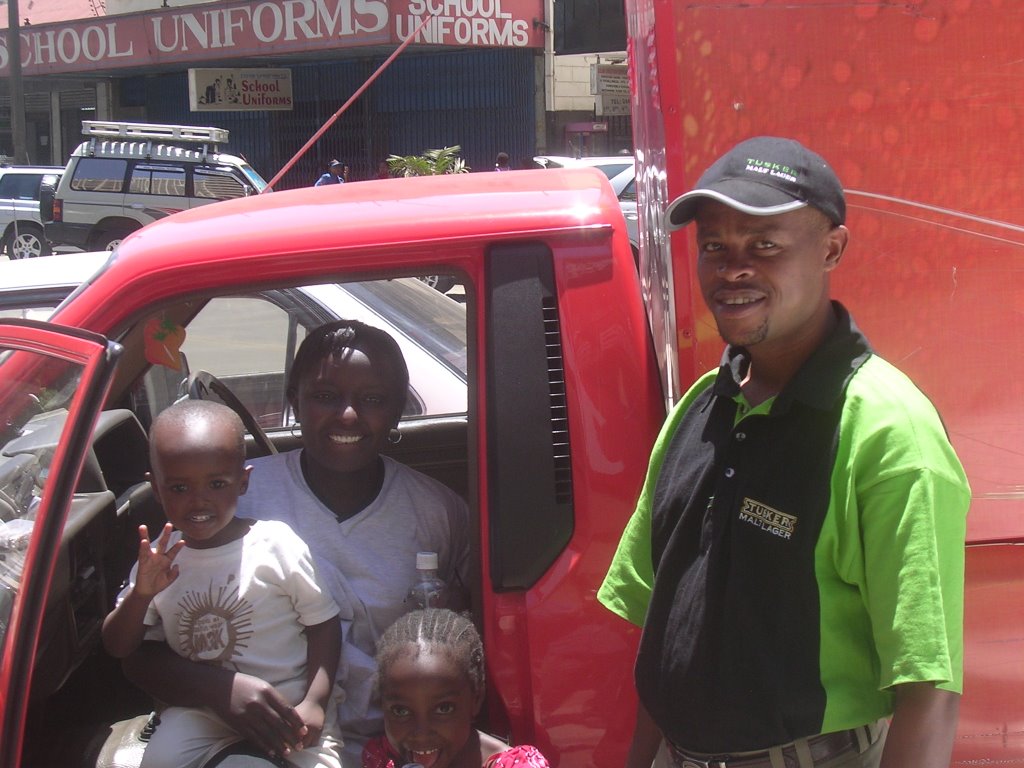
I meet Lucy and her husband Kim for lunch and also meet their son Geoff and their niece Kandi. Geoff reminds me of Nate. He refuses to stay in his seat, but wanders around the restaurant, giving me an excuse to chase him and scoop him up and hold him.
I go to Machakos in the afternoon and hangout with Anne and her friend Andrew. I'd been to Kenyan bars and nyama choma joints before, but had never spent the whole afternoon in such a place. I'm not so much on those typical male interests of football on TV, beer, roast meat, lots of pictures of women on the walls but only one (Anne) in actual attendance. Still, I had a good time-- there are few things I enjoy doing more than something I don't normally do.
Subscribe to:
Posts (Atom)